


Téléchargez l'application et débloquez gratuitement les meilleurs spots pour the cero fish !
Télécharger l'applicationThe Cero fish
October to December
30 cm
Avez-vous pêché
cette espèce ce mois-ci ?
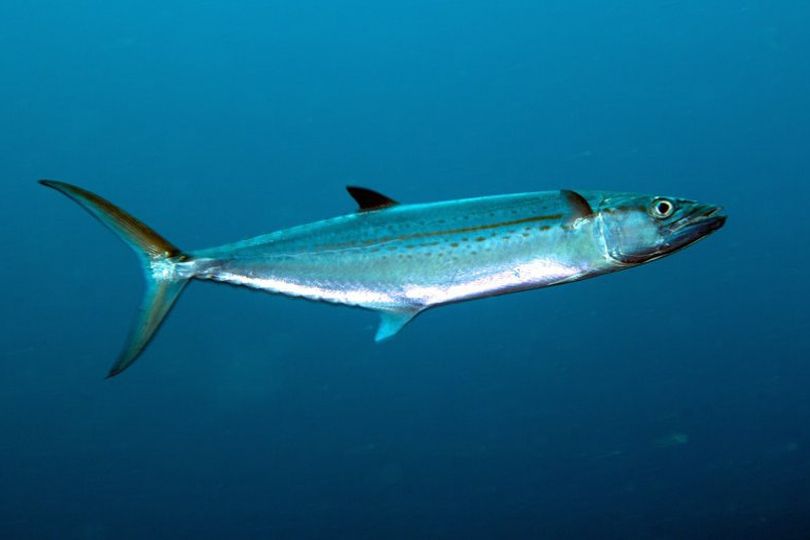
The Cero Fish belongs to the Scombridae family. The maximum size known for the Cero fish is 83 cm and a maximum weight of 7.8 kg and its usual size is about 38 cm. It can live to be 11 years old. It reproduces from April to October in general. It is abundant from October to December.
The cero fish has an elongated and streamlined body which is well suited for swimming at speeds of up to 48 km/ h. The body is covered with small scales; the lateral line being inclined towards the caudal peduncle. The caudal fin is lunar and the pelvic fins are relatively long. The scales extend over the pectoral fins. The spiny and soft dorsal fins are separated, with the soft dorsal fin corresponding to the anal fin just below. A series of pinnules follows each fin and three pins on each side of the caudal peduncle. The swim bladder is absent in the cero fish. The back is iridescent bluish green with silvery sides and belly. A semi-lateral bronze band extends from the pectoral fin to the base of the caudal fin. There are several rows of yellow-orange streaks with yellow spots forming lines above and below the sideband. The front third of the first dorsal fin is bluish black.
The Cero fish lifestyle
It feeds mainly on clupeid fish, including herring, as well as silversides of the genus Allanetta. The diet of cero mackerel also includes squid and shrimp.
Females between 38 and 80 cm release 160,000 to 2.23 million eggs each. This species has floating and oviparous eggs and a pelagic larva. Eggs generally measure between 0.34 and 0.36 mm in diameter and hatch between1.16 and 1.22 mm. During larval development, the caudal fin appears first, followed by the development of the first dorsal, second dorsal, anus and finally the pelvic pectoral fin.
The Cero fish habitat
The Cero fish sometimes form schools on wrecks, coral reefs and along projections at depths ranging from 1 to 20 m. It is usually found at mid-water and near the water surface.
It can be found in the western Atlantic Ocean, from Massachusetts, the United States to Brazil, the Bahamas and the West Indies. It is common in the Caribbean, Bahamas and Florida.
Toute l'info pêche autour de vous
Spots, Prises, sorties, prévisions météo, concours...
sur l'appli ComptoirDesPêcheurs !



The Cero fish angling
The cero is caught with gillnets and on lines.
On a testé pour vous !

Suivi de l'activité de pêche récréative en France
Depuis 2020, une étude approfondie sur la pêche récréative en mer a été initiée en France avec une nouvelle approche innovante. Cette démarche implique directement les pêcheurs récréatifs, afin de collecter...
FIIISH BLASTER SHAD, un leurre innovant pour la pêche du brochet !
Après 5 années de recherche et de développement, Fiiish, la marque du célébrissime Black Minnow, a lancé un leurre ultra-innovant équipé du Player Concept, un système très ingénieux permettant de pouvoir...
Leurre Black Minnow : une décennie et pas une ride !
Déjà 10 ans que la société bretonne Fiiish a lancé dans le commerce le leurre souple Black Minnow et bien lui en a pris pour le plus grand bonheur des pêcheurs....
La Salmo Trek : le rendez-vous pêche incontournable de cet été !
Envie de relever un nouveau défi de pêche dans un lieu magnifique ? ...
Nouvelle appli ComptoirDesPêcheurs : toute la pêche (très bientôt) dans votre poche !
Sur votre smartphone - Android ou Apple - la toute nouvelle version de l'application ComptoirDesPêcheurs va bientôt devenir votre outil indispensable pour toutes vos pêches ! Un véritable "couteau-suisse digital" qui vous...
Nouveau : Caperlan lance un service de commande en ligne pour vos appâts vivants mer & eau douce !
Bonne nouvelle ! Pour continuer à pratiquer votre passion, vous pouvez désormais (en + des produits habituels) commander vos appâts vivants mer & eau douce en ligne et les retirer dans...
On a essayé pour vous le 905 Pilothouse de Quicksilver
Conçu à la fois pour la pêche, l’aventure et le plaisir, en toute sécurité et total confort, le 905 Pilothouse convient pour la croisière en haute mer (catégorie B) avec une...