


Téléchargez l'application et débloquez gratuitement les meilleurs spots pour the bloater fish !
Télécharger l'applicationThe Bloater fish
All year
no restriction
Avez-vous pêché
cette espèce ce mois-ci ?
The Bloater fish belongs to the Salmonidae family. It has a maximum length of 37 cm for an average size of 25 cm. It has a maximum lifespan of 10 years. It spawns all year round with a peak in fall or winter. It can be fished all year round.
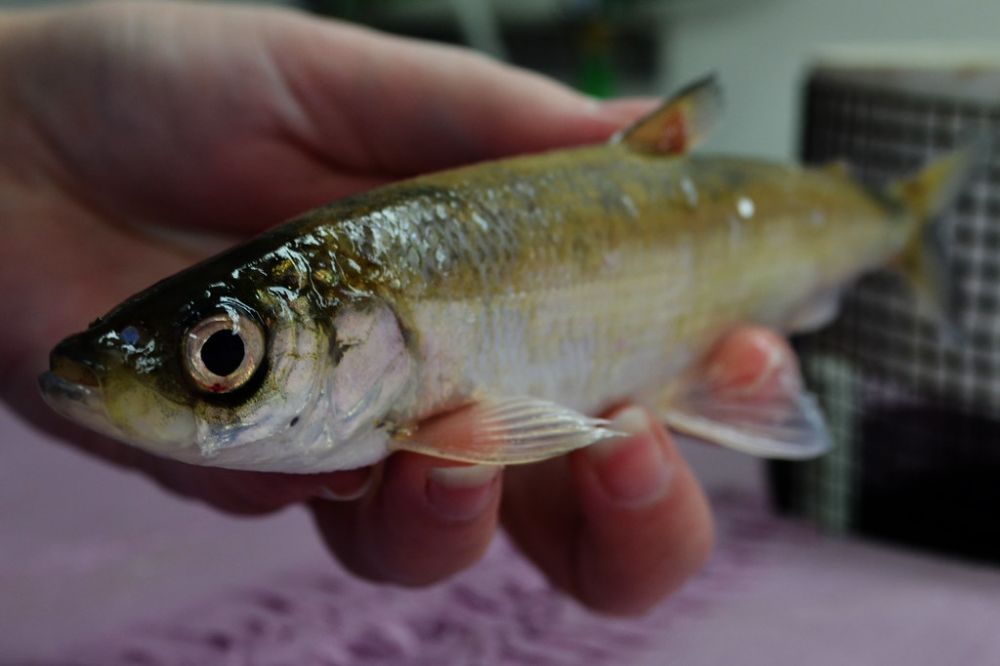
The bloater is a small silvery white fish with a pink and purple iridescence. It has a greenish hue above and a whitish belly. It is very similar to kiyi, which distinguishes it by its lighter upper lip and smaller eye. Its body is deepest in its middle, its fins are small and pale and it has 40-47 gills.
The Bloater fish lifestyle
The Bloater fish mainly feeds on animals living at the bottom of the lake (zoobenthos), but sometimes eats small drifting animals, or zooplankton.
Spawning occurs all year round, but usually in winter or fall. Spawning occurs at depths of 37 to 92 meters. The number of eggs produced by the female varies according to her size and ranges from 3,230 to 18,768. The eggs incubate for 4 months and the bloating is 1.01 cm long at hatching. Larval bloater moves to the cold bottom of lakes before becoming pelagic and, from their first summers, they become bottom dwellers. Larval bloating has a high mortality rate until it becomes large enough to avoid predation by other bloating and alewives. It grows slowly due to the scarcity of food in its habitat. The average length of the balloon at maturity is 18.3 centimeters.
The Bloater fish habitat
The bloater fish lives is at a depths of 30 to 198 meters. There, it lives on underwater slopes and tolerates temperatures between 1.5 and 11.4 degrees Celsius. When it come to the surface, its gas bladder expands, giving it a swollen appearance.
The bloater originates from all the Great Lakes (except Lake Erie) and Lake Nipigon. It is in decline throughout its range and the IUCN Red List classifies it as vulnerable to global extinction. It has disappeared from Lake Ontario and Lake Nipigon, is rare in Lake Michigan and is declining in Lakes Superior and Huron. This decline is mainly caused by alewife predation, predation and lamprey pollution.
Toute l'info pêche autour de vous
Spots, Prises, sorties, prévisions météo, concours...
sur l'appli ComptoirDesPêcheurs !



The Bloater fish angling
It can be fished by bottom fishing.
On a testé pour vous !

Suivi de l'activité de pêche récréative en France
Depuis 2020, une étude approfondie sur la pêche récréative en mer a été initiée en France avec une nouvelle approche innovante. Cette démarche implique directement les pêcheurs récréatifs, afin de collecter...
FIIISH BLASTER SHAD, un leurre innovant pour la pêche du brochet !
Après 5 années de recherche et de développement, Fiiish, la marque du célébrissime Black Minnow, a lancé un leurre ultra-innovant équipé du Player Concept, un système très ingénieux permettant de pouvoir...
Leurre Black Minnow : une décennie et pas une ride !
Déjà 10 ans que la société bretonne Fiiish a lancé dans le commerce le leurre souple Black Minnow et bien lui en a pris pour le plus grand bonheur des pêcheurs....
La Salmo Trek : le rendez-vous pêche incontournable de cet été !
Envie de relever un nouveau défi de pêche dans un lieu magnifique ? ...
Nouvelle appli ComptoirDesPêcheurs : toute la pêche (très bientôt) dans votre poche !
Sur votre smartphone - Android ou Apple - la toute nouvelle version de l'application ComptoirDesPêcheurs va bientôt devenir votre outil indispensable pour toutes vos pêches ! Un véritable "couteau-suisse digital" qui vous...
Nouveau : Caperlan lance un service de commande en ligne pour vos appâts vivants mer & eau douce !
Bonne nouvelle ! Pour continuer à pratiquer votre passion, vous pouvez désormais (en + des produits habituels) commander vos appâts vivants mer & eau douce en ligne et les retirer dans...
On a essayé pour vous le 905 Pilothouse de Quicksilver
Conçu à la fois pour la pêche, l’aventure et le plaisir, en toute sécurité et total confort, le 905 Pilothouse convient pour la croisière en haute mer (catégorie B) avec une...