


Téléchargez l'application et débloquez gratuitement les meilleurs spots pour the river lamprey !
Télécharger l'applicationThe River Lamprey
January to May
20 cm
Avez-vous pêché
cette espèce ce mois-ci ?
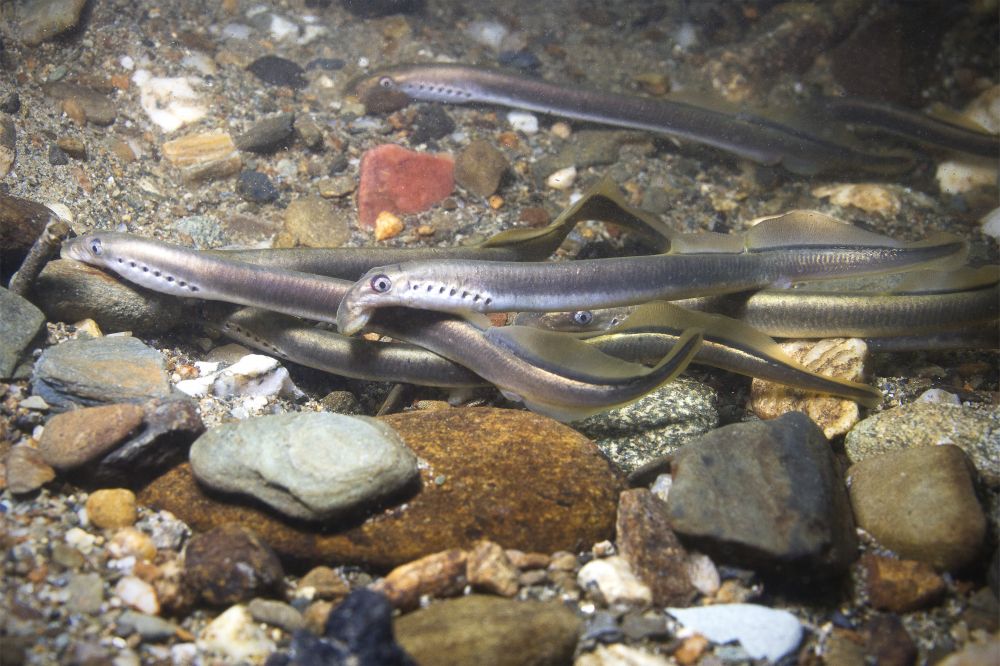
The River Lamprey belongs to the Petromyzontidae family. It measures 18 to 50 cm (average 25 to 35 cm) and weighs 30 to 150 g (average 50 to 70 g). Females are larger than males. The maximum age of the river lamprey is estimated at 10 years. Reproduction takes place between January and May. The number of eggs varies between 4,000 and 40,000. It is caught from January to May.
A vertebrate with a cartilaginous skeleton and no jaws, the river lamprey has an anguilliform body, without scales and covered with toxic mucus. Its back is bluish to brownish green. Its sides are greyish, tanned, without mottling. The belly is white. The eyes are very well developed but remain primitive. A single nostril is located between the two eyes. In adults, the circular mouth in the lower position is a suction cup adapted to suction. The buccal disc and tongue are covered with only a few horny denticles, but most of them are strong and acute. On each side of the head, this species has seven pairs of circular gill holes (spiracules). The river lamprey has three fins: one caudal and two dorsal. The two dorsal fins are separated by a small interval, the second being triangular in shape, longer and higher than the first. The larvae are light-colored and its mouth is horseshoe-shaped. His eyes remain hidden under the skin. So it’s blind.
The River Lamprey lifestyle
In the larval stage:
The ammocete larvae, blind, live buried in silty substrates along the shoreline and filter micro-organisms, such as diatoms.
As an adult:
When it reaches a size of about 13 cm in summer, the river lamprey metamorphoses, then migrates to the sea in autumn. Its feeding pattern becomes parasitic. It is growing rapidly. It clings to fish with its mouth and tears off their flesh with its toothed tongue. The host's blood remains fluid thanks to an anticoagulant contained in its saliva (lamphredine). By sticking her mouth suction cup on the host's body, It feeds on the host's blood, flesh and body fluids. Its prey is diverse: mainly mullets, but also pollachius pollachius, salmon, herring, shad...
The river lamprey is an anadromous: as an adult, it usually lives at sea but swims up rivers and streams to lay its eggs. This migration takes place in January/February. During the run, the spawners do not feed and live on their reserves. Their weight decreases sharply and their body becomes thinner. They can go back a long way. Spawning takes place in rivers between March and May, in waters with temperatures ranging from 10 to 14°C. During breeding, the female rebuilds her nest and attaches herself with her suction cup to the larger rollers, facing the current. Reproduction can be collective, with about ten individuals occupying the nest. The river lamprey lays eggs in the nest when the male, by attaching himself to his head and hugging him, helps him to expel the eggs it fertilizes. The number of eggs varies from 4,000 to 40,000. They measure 1 mm. Adults die after reproduction.
Toute l'info pêche autour de vous
Spots, Prises, sorties, prévisions météo, concours...
sur l'appli ComptoirDesPêcheurs !



The River Lamprey habitat
They are found in Eastern and Northern Europe (Gulf of Bosnia, British, Irish and Southern Norwegian coasts) to Southern Europe (Portugal, Italy). This lamprey is present everywhere in France, but it remains rare in Brittany.
This species is also found in Ladoga and Onega lakes in Russia, and in Scottish and Finnish lakes.
The River lamprey angling
Fishing for river lampreys is carried out from January to May. A net or burls are then used to catch it.
On a testé pour vous !

Suivi de l'activité de pêche récréative en France
Depuis 2020, une étude approfondie sur la pêche récréative en mer a été initiée en France avec une nouvelle approche innovante. Cette démarche implique directement les pêcheurs récréatifs, afin de collecter...
FIIISH BLASTER SHAD, un leurre innovant pour la pêche du brochet !
Après 5 années de recherche et de développement, Fiiish, la marque du célébrissime Black Minnow, a lancé un leurre ultra-innovant équipé du Player Concept, un système très ingénieux permettant de pouvoir...
Leurre Black Minnow : une décennie et pas une ride !
Déjà 10 ans que la société bretonne Fiiish a lancé dans le commerce le leurre souple Black Minnow et bien lui en a pris pour le plus grand bonheur des pêcheurs....
La Salmo Trek : le rendez-vous pêche incontournable de cet été !
Envie de relever un nouveau défi de pêche dans un lieu magnifique ? ...
Nouvelle appli ComptoirDesPêcheurs : toute la pêche (très bientôt) dans votre poche !
Sur votre smartphone - Android ou Apple - la toute nouvelle version de l'application ComptoirDesPêcheurs va bientôt devenir votre outil indispensable pour toutes vos pêches ! Un véritable "couteau-suisse digital" qui vous...
Nouveau : Caperlan lance un service de commande en ligne pour vos appâts vivants mer & eau douce !
Bonne nouvelle ! Pour continuer à pratiquer votre passion, vous pouvez désormais (en + des produits habituels) commander vos appâts vivants mer & eau douce en ligne et les retirer dans...
On a essayé pour vous le 905 Pilothouse de Quicksilver
Conçu à la fois pour la pêche, l’aventure et le plaisir, en toute sécurité et total confort, le 905 Pilothouse convient pour la croisière en haute mer (catégorie B) avec une...