


Téléchargez l'application et débloquez gratuitement les meilleurs spots pour seabass !
Télécharger l'applicationSeabass
Refer to section below
40 cm
Avez-vous pêché
cette espèce ce mois-ci ?
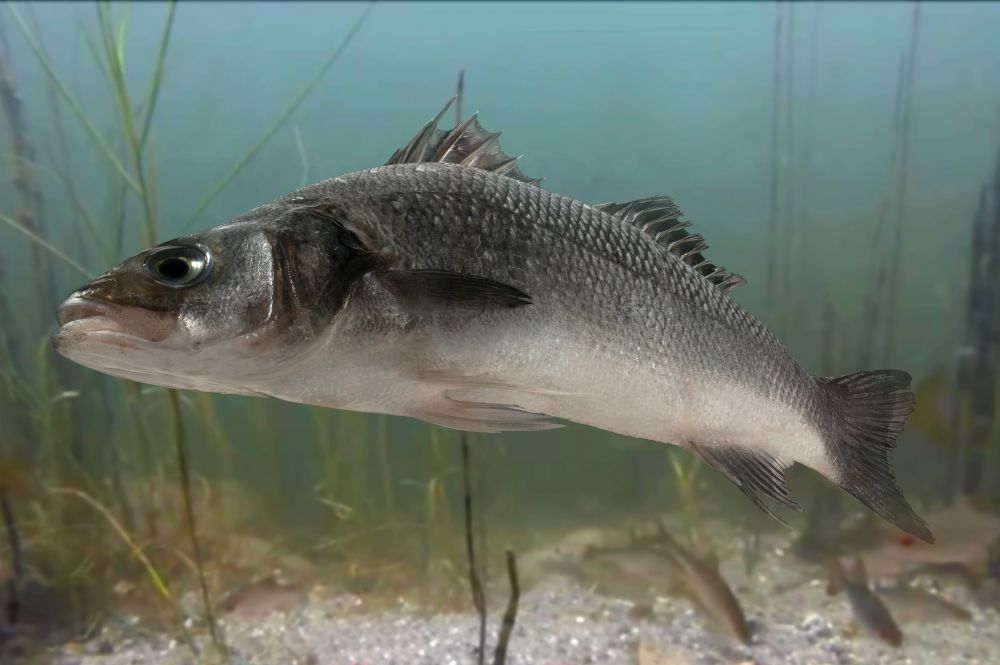
The Seabass belongs to the Moronidae family. Its size is usually between 70 and 80 cm (1.10 m maximum). The life expectancy of the seabass is variable: about thirty years in an aquarium, 24 years in Ireland, 6 years maximum most often in the Mediterranean. Breeding takes place between December and March or January to May depending on the location. The female lays 200,000 eggs at once.
The body of this fish is elongated and slightly compressed. The two dorsal fins (the first thorny and the second soft) are well separated and have almost the same length and height. The anal fin is composed of 10 soft rays preceded by 3 thorny rays. The caudal peduncle is quite elongated and the caudal fin is indented, with an upper lobe often slightly longer than the lower lobe. The pectoral fins are short. The upper part of the head is quite straight, the upper jaw is a little shorter than the lower jaw. The operculum may have a more or less visible black spot in its posterior upper part. The scales are small in size but clearly visible. The lateral line is slightly arched in the front part of the body. The back is grey in color, the sides are lighter, with yellowish or silvery reflections. The pectoral and ventral fins are yellowish white; the others are darker. Mostly in young individuals, black spots may be present in the dorso-ventral region.
When and where you can catch seabass ?
Throughout 2019 you must not catch, retain, tranship or land bass caught from a vessel or the shore from the following ‘prohibited’ areas:
Sea area and International Council for the Exploration of the Sea (ICES) division:
South West Approaches: ICES VIIb, VIIc, VIIj and VIIk
Irish or Celtic Sea Outside the 12 nautical mile limit of UK waters in ICES VIIg and VIIa
During January 2019 and from 1 April 2019 until 31 December 2019 the catch, retention, transhipment and landing of bass in the restricted areas below, is only permitted if you have an authorisation from the MMO to do so. Fishing for bass in any restricted area is prohibited during February and March 2019.
Sea area and International Council for the Exploration of the Sea (ICES) division:
North Sea: IVb, IVc
Channel: VIId, VIIe
Celtic Sea: VIIf, VIIg*
Irish Sea: VIIa*
South West Approaches: VIIh
(*Inside UK 12nm limit only)
The seabass lifestyle
Young people and sub-adults consume mainly
crustaceans. Adults still eat crustaceans, but also cephalopods (squid), and
especially fish (sardines, anchovies, pouts...). Hunting is done either by
individuals alone on the lookout, near the bottom, or in front of the current
or in the eddies. Pelagic fish can also be hunted by schools of sea bass. The seabass
has a reputation for great voracity but also mistrust.
Spawning takes place on the coast, at a depth of
less than 10 m, between December and March in the Mediterranean and is spread
from January to May in the Atlantic, English Channel and North Sea. The female lays 200,000 eggs at once. The male follows a female with a swollen
abdomen, and fertilization is external. The eggs are pelagic, when the larva
hatches, as long as it has yolk, swims with its stomach in the air.
Toute l'info pêche autour de vous
Spots, Prises, sorties, prévisions météo, concours...
sur l'appli ComptoirDesPêcheurs !



The Seabass habitat
This fish is found mainly above the sandy or
rocky bottom of the coastal fringe. It enters brackish waters and ports.
Juveniles have already been observed in the terminal part of coastal rivers. It
can be found between the surface, in the rough waters where it hunts, and about
30 meters deep (exceptionally 100 m).
It is found in the Mediterranean, the North-East
Atlantic, from Norway to Morocco.
The Seabass angling
A
highly sought-after species, it can be fished in many different ways. Bass is
also fished by bottom trawl or trawl, trolling line and longline, and is fished
all year round, from February to April for individuals fished by trawl and from
April to December for line bass.
On a testé pour vous !

Suivi de l'activité de pêche récréative en France
Depuis 2020, une étude approfondie sur la pêche récréative en mer a été initiée en France avec une nouvelle approche innovante. Cette démarche implique directement les pêcheurs récréatifs, afin de collecter...
FIIISH BLASTER SHAD, un leurre innovant pour la pêche du brochet !
Après 5 années de recherche et de développement, Fiiish, la marque du célébrissime Black Minnow, a lancé un leurre ultra-innovant équipé du Player Concept, un système très ingénieux permettant de pouvoir...
Leurre Black Minnow : une décennie et pas une ride !
Déjà 10 ans que la société bretonne Fiiish a lancé dans le commerce le leurre souple Black Minnow et bien lui en a pris pour le plus grand bonheur des pêcheurs....
La Salmo Trek : le rendez-vous pêche incontournable de cet été !
Envie de relever un nouveau défi de pêche dans un lieu magnifique ? ...
Nouvelle appli ComptoirDesPêcheurs : toute la pêche (très bientôt) dans votre poche !
Sur votre smartphone - Android ou Apple - la toute nouvelle version de l'application ComptoirDesPêcheurs va bientôt devenir votre outil indispensable pour toutes vos pêches ! Un véritable "couteau-suisse digital" qui vous...
Nouveau : Caperlan lance un service de commande en ligne pour vos appâts vivants mer & eau douce !
Bonne nouvelle ! Pour continuer à pratiquer votre passion, vous pouvez désormais (en + des produits habituels) commander vos appâts vivants mer & eau douce en ligne et les retirer dans...
On a essayé pour vous le 905 Pilothouse de Quicksilver
Conçu à la fois pour la pêche, l’aventure et le plaisir, en toute sécurité et total confort, le 905 Pilothouse convient pour la croisière en haute mer (catégorie B) avec une...