


Téléchargez l'application et débloquez gratuitement les meilleurs spots pour tuna !
Télécharger l'applicationTuna
All the year
25 inches
Avez-vous pêché
cette espèce ce mois-ci ?
Tuna is a popular and prized fish during recreative fishing games. Here is some useful information about Bigeye and Yellowfin if you want to fish in the Atlantic or Pacific Ocean.
Introduction
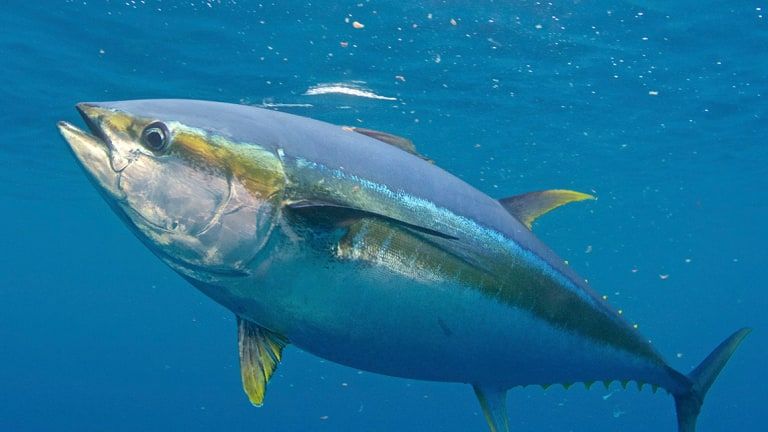
Bigeye tuna (thunnus obesus) and Yellowfin tuna (thunnus albacares) spend their lives in warm aquatic areas. They are very popular and can be confused with one another because of their close physical likeness. Actually, these two types of tunas are a bit different: Bigeye has a slightly larger eye and its second dorsal and anal fins are shorter than a Yellowfin’s.
Bigeye tuna lives in temperate waters in tropical areas. It is between 60 and 250 cm long and its pectoral fins are as long as its second dorsal fin. Its body reflects the color of most tunas: metallic blue on the back, changing to white and silver on the belly and iridescent blue along the flanks. Dorsal and anal fins show a yellowish color. US fishermen report they often catch Bigeye tuna on their lines while they are fishing swordfish.
As for Yellowfin tuna, its length can be up to 240 cm and it can weigh up to 200 kg. It can be differentiated from Bigeye tuna thanks to a long yellow strip extending from its head to its tail. You can see metallic blue on the back and silver on the belly. Yellowfin tuna is also very appreciated by sport fishers. It is sometimes confused with Bluefin, which is another kind of tuna that lives in the same areas.
From February to May
Pole-and-line tuna vessels catch very few Bigeye and Yellowfin tuna from February to May, especially in the Atlantic Ocean whereas a seasonal index is difficult to estimate for tuna seiners in both Atlantic and Pacific Oceans because fishing seasons are different from one region to another. However, both Bigeye and Yellowfin tunas are easier to catch well after sundown or around one hour before the sunset.
Toute l'info pêche autour de vous
Spots, Prises, sorties, prévisions météo, concours...
sur l'appli ComptoirDesPêcheurs !



From May to November
It is easier to catch Bigeye and Yellowfin tunas from May to November, especially in June and from September to November for thunnus albacares, and from May to July for thunnus obesus. During spring and autumn, they indeed tend to move in the fishing areas because of the mild temperatures. Also during summer Yellowfin tunas are very numerous inside the canyons when the water temperature is higher than usual. If you are fishing around the US, there is no doubt you will be able to catch one or several of them on your line.
From November to January
During early winter, Bigeye and Yellowfin tunas tend to move off from cold areas in the Pacific and Atlantic Oceans as they prefer living in warmer areas. Fishers find it more difficult to fish, but it is not impossible to have a big catch on pole-and-line vessels and seiners as well.
On a testé pour vous !

Suivi de l'activité de pêche récréative en France
Depuis 2020, une étude approfondie sur la pêche récréative en mer a été initiée en France avec une nouvelle approche innovante. Cette démarche implique directement les pêcheurs récréatifs, afin de collecter...
FIIISH BLASTER SHAD, un leurre innovant pour la pêche du brochet !
Après 5 années de recherche et de développement, Fiiish, la marque du célébrissime Black Minnow, a lancé un leurre ultra-innovant équipé du Player Concept, un système très ingénieux permettant de pouvoir...
Leurre Black Minnow : une décennie et pas une ride !
Déjà 10 ans que la société bretonne Fiiish a lancé dans le commerce le leurre souple Black Minnow et bien lui en a pris pour le plus grand bonheur des pêcheurs....
La Salmo Trek : le rendez-vous pêche incontournable de cet été !
Envie de relever un nouveau défi de pêche dans un lieu magnifique ? ...
Nouvelle appli ComptoirDesPêcheurs : toute la pêche (très bientôt) dans votre poche !
Sur votre smartphone - Android ou Apple - la toute nouvelle version de l'application ComptoirDesPêcheurs va bientôt devenir votre outil indispensable pour toutes vos pêches ! Un véritable "couteau-suisse digital" qui vous...
Nouveau : Caperlan lance un service de commande en ligne pour vos appâts vivants mer & eau douce !
Bonne nouvelle ! Pour continuer à pratiquer votre passion, vous pouvez désormais (en + des produits habituels) commander vos appâts vivants mer & eau douce en ligne et les retirer dans...
On a essayé pour vous le 905 Pilothouse de Quicksilver
Conçu à la fois pour la pêche, l’aventure et le plaisir, en toute sécurité et total confort, le 905 Pilothouse convient pour la croisière en haute mer (catégorie B) avec une...